Go Kart Seats – Precision, Fit and Control in Karting
Kart seats are a key component for driving feel, control and overall performance. They directly connect the driver to the chassis and significantly influence seating position, weight distribution and on-track feedback. Choosing the right kart seat is therefore crucial.
Our range includes high-quality kart seats designed for a wide variety of requirements and developed specifically for racing conditions. Different seat shapes, sizes and flex characteristics allow precise adjustment to the driver, chassis and application – from ambitious hobby drivers to professional racing teams.
Our kart seats are built for use in national and international karting and meet the highest standards in material quality and workmanship. We also provide detailed guidance on selection, installation and setup to help you unlock the full potential of your seat and chassis.
Guide:
How to Find the Right Kart Seat
The right seat is a crucial factor for a properly functioning kart chassis on track. Whether you are a hobby racer, club driver or professional – the correct seat has a major impact on your driving feel. In this guide, we show you what to look for when choosing a kart seat.
1. Why Is the Right Seat So Important?
An optimally fitted kart seat…
- improves seating position, contributing to perfect weight distribution
- reduces rib injuries and bruising
- increases comfort by keeping the driver firmly and securely positioned in the kart
- supports performance, as less muscular effort is required to stabilize the body
2. Seat Sizes and Shapes
A seat must match your height, body shape and driving style.
- Make sure to choose the correct seat width and height
- Check whether the seat properly supports your leg position and hips
- Smaller, dedicated seats are available for children and junior drivers
👉 Tip: Many manufacturers provide size charts with recommended body measurements – compare these carefully when selecting your seat. Keep in mind that seat sizes can vary significantly between different manufacturers.
👉 Tip: A slightly larger seat may seem like the “better” choice at first glance. This assumption is incorrect. A seat that is too large can lead to bruising and rib injuries, as the body is not properly secured and will move excessively while driving.
3. Material & Comfort
Kart seats are typically made from:
- Fiberglass – lightweight, strong and widely used in racing
- Plastic/composite – more robust and often more affordable
Additional comfort can be achieved through:
👉 Tip: In the past, fully or partially padded seats were standard. Today, these models are rarely used, as they can negatively affect driving feel. Modern setups typically use targeted padding only in specific problem areas such as the back or ribs.
4. Seat “Hardness”
The flexibility of the seat, or more precisely its lateral stiffness, has a significant influence on chassis behavior. Due to its leverage effect within the chassis structure, the seat plays a major role in overall handling characteristics.
For this reason, premium manufacturers offer not only different seat shapes and sizes, but also a wide range of stiffness levels.
👉 Tip: The correct seat stiffness is often underestimated. Most well-known chassis manufacturers provide recommendations for seat stiffness depending on chassis type, engine package and tire selection.
FAQ
How Do I Find the Right Seat Size?
Case 1: You already have a roughly suitable seat
In this case, finding the correct size is relatively straightforward. By measuring the existing seat and comparing the dimensions with the manufacturer’s size charts, the appropriate seat size can usually be determined without difficulty.
Case 2: No reference seat is available
In this situation, the process is more challenging. Your height, weight and body type serve as the main reference points. These details can be matched with the manufacturer’s size charts to determine a suitable seat size.
👉 Tip: If the correct size cannot be clearly determined, we recommend ordering two or three different sizes for fitting. The seats that do not fit can then be returned. While slightly more time-consuming, this is the only way to ensure you find the optimal size with complete confidence.
👉 Tip: Always test-fit the seat wearing your full racing gear (suit, rib protector, underwear).
Three of the Most Common Mistakes We Constantly See in the Paddock
Incorrect seat position. The correct seat position is a fundamental requirement for a perfectly functioning chassis.
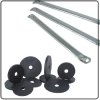
Incorrect or unsafe installation! This can be dangerous. Washers between the seat and the seat struts are mandatory to prevent the strut from penetrating the seat – and potentially the driver’s body – in the event of a side impact accident.
Incorrect mounting method. In addition to seat stiffness, the way the seat is mounted significantly affects chassis behavior. In practice, this detail is often underestimated. Whether a seat is fully rigidly mounted with additional seat stays or only lightly secured has a major influence on handling characteristics.